Adult protective services (APS) investigates cases of suspected abuse, neglect, and exploitation occurring in community settings that involve older adults aged 65+ and certain younger adults aged 18-64 with disabilities (see Links & FAQs for details). APS also coordinates resources and services needed to improve the adult’s situation, stop the harm they’re experiencing, and reduce the risk of the harm occurring again in the future.
All investigations of abuse and exploitation require allegations of harm caused by someone who is known to the vulnerable adult. Neglect investigations can either involve allegations that someone known to the vulnerable adult is neglecting their needs, or allegations that the vulnerable adult is unable to live independently or care for themselves (which is called “self-neglect”).
In Texas, the APS program is run through the Department of Family and Protective Services. The APS staff have access to limited state funds to provide needed resources for the vulnerable adults they serve. Since state funds can’t provide everything needed to alleviate the impact of the abuse, neglect, and exploitation that they’re facing, APS programs statewide establish and nurture partnerships with their communities through the Partnering to Protect initiative. By partnering with professionals and interested community members, APS ensures that the adults they serve have the strength of their communities behind them as they work to overcome their experiences and circumstances.
A central part of the Partnering to Protect initiative is a network of organizations specifically dedicated to supporting the work that APS does. These organizations, collectively called the Texas Partners for APS, provide education, resources, and support to APS staff and the clients they serve. Texas APS is divided into 11 regions, with Region 6 made up of 13 counties in and around Houston. Currently, the Region 6 APS Advisory Board is the only group affiliated with Texas Partners for APS that operates in Region 6.
NOTE: This is the website of the Region 6 APS Advisory Board. We support our region’s APS program, but we are not APS.
You can find resources and more information on our Links & FAQs page, or call the Texas Abuse Hotline at (800) 252-5400 to make an APS report.
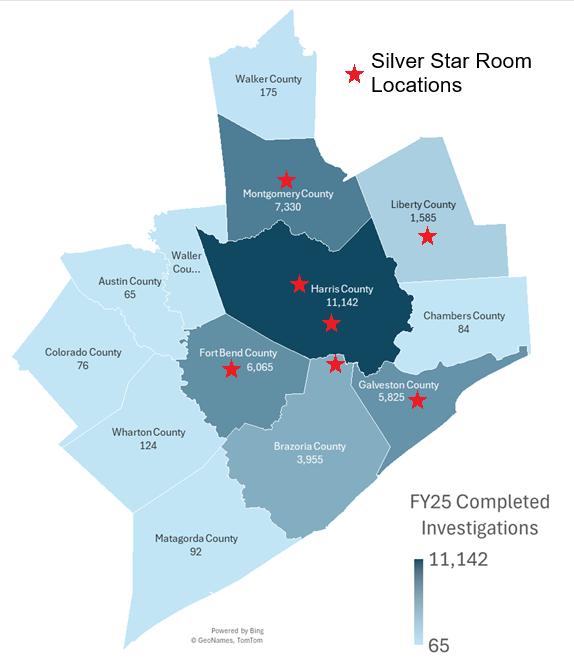
APS Region 6 is made up of 13 counties, as shown on this map. The map also indicates the number of investigations APS completed in each county in fiscal year 2025, as well as the locations of the seven Silver Star Rooms throughout the region.
Efforts to develop a volunteer board to support the APS program in Region 6 were initiated in 2001 by Imogen Papadopoulos, a local elder law attorney, and Jan McLaughlin, the Department of Family and Protective Services lead administrator. The founding members of the Region 6 APS Advisory Board established broad goals and objectives to improve services and supports for vulnerable adults. Board objectives included education, mobilizing resources to support APS caseworkers in the field, and developing and promoting intervention strategies designed to prevent and alleviate occurrences of abuse, neglect, and exploitation of vulnerable adults.
The Board was recognized as a 501(c)(3) nonprofit organization in 2003. Since then, it has continuously worked with public and private organizations to educate the community about issues affecting vulnerable adults, through outreach, conferences, and community presentations. The Board has established seven Silver Star Resource Rooms throughout the region. The Board keeps the rooms stocked with essential items for client health and well-being year-round, such as room fans, heaters, clothing, and toiletries. In addition, the Board provides individualized support to clients throughout the region when their needs go beyond what APS is able to provide them.
Our mission is to support and strengthen the protection of vulnerable adults through community collaboration, resource mobilization, and public awareness, in partnership with Adult Protective Services staff in Texas APS Region 6.
We work to achieve this mission by prioritizing six key strategic pillars:
The Region 6 APS Advisory Board is run by an all-volunteer board, working in close coordination and collaboration with the Region 6 APS leadership and community engagement specialists.